The Turing Test: Computing Machinery and Intelligence (1950)
What Turing's 1950 imitation game actually tests, the objections the paper answers, and what it does not prove.
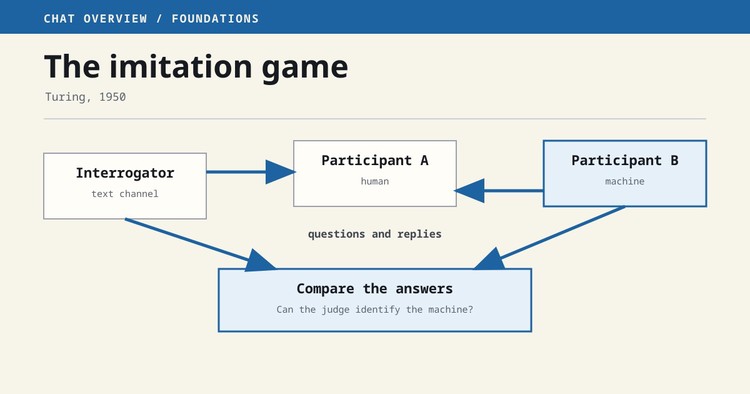
Alan Turing opened his 1950 paper Computing Machinery and Intelligence with a problem: the question "Can machines think?" depends on two words that are difficult to define. He replaced it with an operational experiment called the imitation game.
In the machine version of the game, an interrogator exchanges typed messages with a person and a computer in separate rooms. The interrogator tries to identify which is which. The computer tries to be mistaken for the person. Text is used so that appearance, voice, and mechanical speed do not give the answer away.
The proposal is now called the Turing Test, although Turing did not use that name in the paper. It is a test of conversational behavior under stated conditions. It is not a direct measurement of consciousness, emotion, truthfulness, or general competence.
The Imitation Game
The original setup begins with a game involving a man, a woman, and an interrogator. Turing asks what would happen if a machine took one participant's place. This framing has produced several interpretations of the exact protocol, but the lasting idea is straightforward: judge the machine by sustained interaction instead of inspecting what it is made from.
That substitution was useful because a digital computer and a human brain work differently. Requiring a machine to share human biology would settle the question by definition. A behavioral test allows different mechanisms to be compared on a common task.
Turing made a concrete prediction. By the end of the twentieth century, he expected machines with enough storage to mislead an average interrogator often enough in a five-minute exchange. The exact forecast is less important than the decision to state observable conditions. It turned an abstract dispute into an empirical research question.
The Machine Turing Had in Mind
The paper focuses on digital computers. Turing describes them in terms of a store, an executive unit, and a control. Programs and data are held in the store; the control follows instructions; the executive unit carries out individual operations. He then argues that a suitable digital computer is a universal machine: given enough memory and time, it can imitate any discrete-state machine.
This matters to the argument. Turing did not need to predict a special physical device for every intelligent behavior. If intelligence could be expressed as effective computation, a programmable digital computer was a plausible host.
He also avoids claiming that one program would imitate every machine efficiently. Universality concerns what can be computed in principle. Memory, time, data, and program design remain practical constraints.
Historical Context
The paper appeared when electronic digital computing was new. Stored-program machines had only recently become operational. "Artificial intelligence" would not become the field's standard label until after the 1956 Dartmouth workshop.
Turing nevertheless discussed natural-language conversation, game playing, learning, search, randomness, and machines that alter their own instructions. He was not describing a modern neural network, but many of the engineering questions are recognizable.
The paper came after McCulloch and Pitts had described idealized neural units in 1943 and before Rosenblatt's perceptron in 1958. Its role in this Foundations series is therefore conceptual. It asks what evidence qualifies before the later articles explain particular learning architectures.
Nine Objections
Turing organizes much of the paper around objections to machine intelligence. Several remain active today.
The theological objection
One argument reserved thought for immortal human souls. Turing replied that this placed an unnecessary restriction on divine power and did not provide an operational reason that a machine could not think.
The consequences objection
Some people reject machine intelligence because the consequences would be frightening. Turing notes that wishing a claim to be false is not evidence that it is false. Modern discussions of labor, control, and safety show that consequences matter for policy, but they do not decide the factual question.
The mathematical objection
Results associated with Goedel and Turing show limits on what formal systems and machines can decide. Turing answers that humans may also be limited and that proving a particular machine has a limitation does not establish general human superiority.
This answer does not erase formal limits. It shows that a limitation must be connected carefully to the proposed comparison.
The argument from consciousness
The strongest version says that no mechanism could think until it writes from felt experience and understands what it has written. Turing observes that applying this standard consistently leads toward solipsism: the only consciousness one can know directly is one's own. In ordinary life, people infer other minds from behavior.
Passing the imitation game therefore provides behavioral evidence, not proof of subjective experience. The distinction is still essential when conversational systems use emotional language.
The disability arguments
These arguments list things a machine supposedly cannot do: be kind, make mistakes, enjoy food, fall in love, or surprise us. Turing treats many as unsupported generalizations from the machines then available. A limitation of current equipment is not necessarily a limit of computation.
Lady Lovelace's objection
Ada Lovelace wrote that Charles Babbage's Analytical Engine could do only what humans knew how to order it to perform. Turing replies that machines frequently surprise their designers. The instructions and learning process may be human-made while their detailed consequences remain unforeseen.
This is not the same as saying that a system creates without causes or training data. It rejects the weaker claim that every output must have been anticipated explicitly by its programmer.
Continuity of the nervous system
The nervous system is continuous while a digital computer is discrete. Turing notes that a discrete system can approximate continuous behavior closely enough that an interrogator may not distinguish the two through conversation.
Informality of behavior
Human conduct does not appear reducible to a complete rulebook. Turing distinguishes explicit rules of conduct from laws of behavior. Failure to state all governing rules does not prove that no systematic description exists.
Extrasensory perception
Turing takes contemporary claims about telepathy seriously and suggests shielding the test. This section reflects the scientific climate of its time and is not needed for the central argument.
The Child Machine
Turing's most forward-looking engineering proposal is to build a child machine rather than directly program an adult mind. He separates three influences: the initial state, education, and experience not included in the education.
The proposal resembles machine learning at a high level. Define an initial system, expose it to a training process, reward or correct behavior, and allow complexity to emerge. Turing discusses punishment and reward signals, randomized variation, and a search through possible programs.
Modern neural-network training is not a direct implementation of his child machine. Backpropagation , datasets, and numerical optimization supply mechanisms the paper does not specify. The conceptual shift is the connection: learned behavior need not be written as a complete list of rules.
Enduring Influence
The imitation game influenced philosophy, computer science, and public culture. It also encouraged systems designed specifically to sustain conversation. The Loebner Prize later formalized an annual version of the test, although short exchanges and incentives to imitate human quirks made it a limited measure of broad intelligence.
Modern language models complicate the picture. A GPT-style model can produce persuasive conversation without a persistent identity, reliable factual model, or independent goal. Conversation remains evidence of a capability, but it does not provide a sufficient account of the system's other properties.
What the Test Does Not Establish
A successful imitation does not by itself establish that a system:
- is conscious or has subjective experience;
- tells the truth or understands the source of a claim;
- performs reliably outside the conversation;
- has general autonomy or persistent goals;
- is safe to deploy in a high-stakes setting.
Those properties require separate definitions and tests. A medical system needs clinical evaluation. A coding assistant needs correctness and security checks. A factual assistant needs source verification. Turing's method remains valuable precisely because it demonstrates how much progress follows from choosing an observable criterion, but one criterion cannot answer every question.
Related Work
- The Perceptron introduces an early trainable neural model.
- Backpropagation explains how multilayer networks learn from examples.
- GPT covers the decoder-only language models that renewed public debate about the test.
- Evolution of Model Architectures places these developments on one timeline.
Further Reading
- Tags:
- Papers
- Architectures