Evolution of Model Architectures
A practical timeline of neural-network architecture, from the perceptron and backpropagation to attention and GPT.
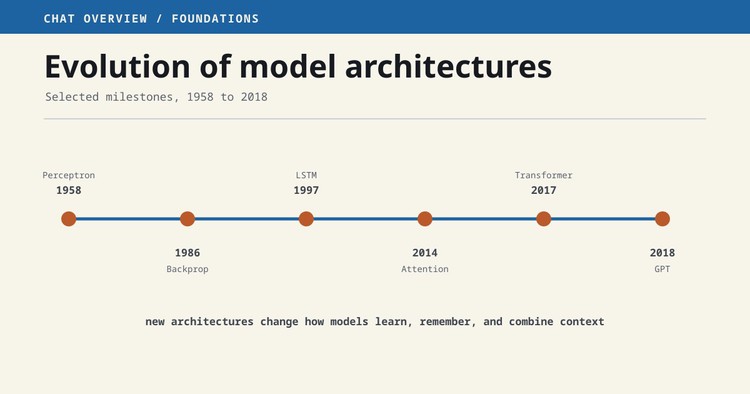
Modern AI did not arrive through a single uninterrupted sequence of better models. Several ideas appeared early, were set aside when data or hardware was insufficient, and returned later in a more practical form. Progress came from architecture, training methods, datasets, compute, and evaluation moving together.
This page is a map of the Foundations series. It follows one main line from trainable linear units to multilayer networks, recurrent memory, attention, and large pretrained Transformers. It leaves out many important branches so that the relationship between the included articles stays clear.
1943 to 1958: Computation and Trainable Units
Warren McCulloch and Walter Pitts described idealized neurons in 1943. Their units combined binary inputs and applied a threshold. Networks of these units could express logical operations, but the paper did not provide a general data-driven learning procedure.
Alan Turing's 1950 paper addressed a different level of the problem. Instead of proposing a neural architecture, it asked what observable evidence qualifies as machine intelligence. Turing also suggested that building a child machine and educating it could be more tractable than programming an adult intelligence directly.
Frank Rosenblatt's perceptron supplied a trainable linear classifier in 1958. Its update rule moved weights when an example was misclassified. For linearly separable data, the perceptron convergence theorem guaranteed that this process would find a separating boundary in finite steps.
The limitation was equally important. One perceptron cannot represent XOR or any other non-linearly separable classification. More expressive networks needed hidden layers and a way to assign credit to their weights.
1960s to 1986: The Hidden-Layer Problem
Multilayer networks were not a new idea in 1986. The difficult part was training their hidden units. There was no direct target for the output of a hidden feature.
The mathematics of reverse-mode differentiation developed across several fields. Paul Werbos described its use for neural networks in the 1970s. Rumelhart, Hinton, and Williams made the approach central to connectionist research with their 1986 paper.
Backpropagation applies the chain rule from the loss backward through a differentiable computation. It calculates a gradient for every weight. An optimizer uses those gradients to reduce loss. This general training mechanism made later architectural experimentation practical.
The historical lesson is not that one paper suddenly invented deep learning. It is that a clear algorithm, working demonstrations, and a receptive research community can turn an existing mathematical idea into a standard tool.
1980s to 1998: Structure for Images and Sequences
A plain multilayer network ignores known structure. Images have local spatial patterns. Sequences have order and state. Two major architecture families built those assumptions into the network.
Convolutional neural networks apply shared local filters across an image. Weight sharing reduces the number of parameters and lets the same feature detector work in different positions. LeCun and colleagues developed these systems from the late 1980s; the 1998 LeNet-5 paper documented a practical handwriting-recognition system.
Recurrent neural networks carry state from one time step to the next. In principle they can represent long dependencies. In practice, gradients often vanish or explode across many steps.
Long short-term memory , published by Sepp Hochreiter and Juergen Schmidhuber in 1997, introduced a memory cell and learned gates. The design gave important error signals a more stable path through time. Later variants added the forget gate and became standard components for language, speech, and time-series systems.
CNNs and LSTMs illustrate inductive bias. Each architecture restricts and organizes computation to match a type of data. This can make learning more efficient than asking an unconstrained network to discover all structure from examples.
The Representation Era
Neural networks did not immediately dominate after backpropagation. Training deep networks remained difficult, labeled datasets were limited, and general-purpose processors were slow for the required matrix operations.
Several developments changed the balance. Larger digital datasets supplied training material. Graphics processors made parallel numerical work much faster. Better initialization, activation functions, regularization, and optimization stabilized deeper networks. In 2006, layer-wise pretraining with deep belief networks helped revive interest in learned hierarchies. In 2012, AlexNet combined a deep CNN, GPUs, ImageNet data, and practical training improvements to win the ImageNet classification challenge by a large margin.
Generative modeling also developed along several branches. Variational autoencoders learned probabilistic latent representations. Generative adversarial networks trained a generator against a discriminator. These are important parts of the history, although this series concentrates on the path toward sequence models and language systems.
2014: Sequence to Sequence
Machine translation needs to map a source sequence of one length to a target sequence of another. Encoder-decoder models made that mapping trainable end to end. An encoder LSTM read the source; a decoder LSTM generated the target.
The initial design compressed the source into one fixed vector. Bahdanau, Cho, and Bengio's attention mechanism let the decoder construct a different weighted combination of source states at each output step. The model learned alignment and translation jointly.
This was a major conceptual change. A network no longer needed to squeeze every source detail into one state. It could retrieve information by content when needed.
2017: The Transformer
The Transformer removed recurrence from its main sequence computation. Self-attention allowed each token representation to combine information from other positions. Large matrix operations made training highly parallel on accelerator hardware.
The original Transformer kept the encoder-decoder layout for translation. Its encoder used bidirectional self-attention. Its decoder used causal self-attention for the generated prefix and cross-attention over the source.
The architecture did not eliminate all sequence costs. Autoregressive generation still produces tokens one at a time, and full attention grows quadratically with sequence length. It did, however, create a flexible block that could be scaled and adapted across domains.
2018 onward: Pretraining and Prompting
The Transformer supported several pretraining strategies.
BERT used an encoder and predicted masked tokens using context from both sides. It produced representations that could be fine-tuned for understanding tasks. T5 retained an encoder-decoder and expressed tasks as text-to-text transformations.
GPT used a causal decoder and next-token prediction. GPT-1 demonstrated generative pretraining followed by task-specific fine-tuning. GPT-2 studied zero-shot transfer. GPT-3 demonstrated in-context learning at much greater scale: instructions and examples in a prompt could specify a task without changing the weights.
The term foundation model describes the resulting development pattern. A broadly trained model becomes a base for many downstream systems. Adaptation can include fine-tuning, instruction tuning, preference optimization, retrieval, tools, or a prompt alone.
Scale played a major role, but "larger" is not a complete explanation. Dataset composition, training stability, architecture details, post-training, and evaluation all affect the observed system.
Beyond Text
Architectural ideas now cross media. Vision Transformers treat image patches as tokens. Speech models encode acoustic frames and decode text. Multimodal models connect image, audio, and language representations. Diffusion models generate images or audio through iterative denoising and often use attention to condition that process on text.
Mixture-of-experts layers route different tokens through different parameter subsets, increasing total capacity without using every parameter for every token. Retrieval-augmented systems bring external documents into the context rather than relying solely on model weights. Tool-using systems let a language model request computation or interact with software.
These are system-level developments as much as architectural ones. A deployed assistant is rarely just a neural network. It includes prompts, retrieval, filters, interfaces, logs, and operational controls.
Common Architectural Themes
Several questions recur across the timeline.
Where is structure encoded?
CNNs assume locality and shared spatial features. RNNs assume an ordered state transition. Transformers provide flexible pairwise access and rely more heavily on data and positional representations.
How does information travel?
In a feed-forward network it moves layer by layer. In an RNN it also moves through time. In attention, distant positions can connect in one layer. Residual connections create shorter routes through deep stacks.
What supplies supervision?
The perceptron used labeled examples. Translation used paired sentences. Language-model pretraining creates targets from raw token sequences. Preference training adds judgments about desirable behavior.
What is trained together?
Older systems often separated feature engineering, prediction, and search. End-to-end learning joins more stages under one objective. That can improve performance, but errors become harder to localize and the objective may reward unwanted shortcuts.
What does scale change?
More parameters and data can improve approximation and transfer. They also increase cost, make training data harder to audit, and complicate evaluation. Scaling is an engineering choice with benefits and externalities, not a substitute for architecture or evidence.
Outlook
The timeline does not end with Transformers. State-space models revisit recurrent processing with hardware-aware implementations. Sparse routing reduces per-token computation. Retrieval separates some knowledge from model parameters. Smaller specialist models trade breadth for cost and control.
The most reliable way to read a new architecture is to ask practical questions. What information can each output use? Which operations are sequential? Which parameters are shared? What objective is optimized? What are the time and memory costs? What evidence compares it with a strong baseline?
Those questions connect new papers to the older work on this page and prevent product names from replacing technical understanding.
Further Reading
- Tags:
- Papers
- Architectures